Saturday, 25 February 2012

ADMIXTURES

Admixtures are chemical materials in the form of powder or fluids. they are added to the concrete before or during mixing. It can give it certain characteristics, for example change its fresh, early age or hardened state of the concrete. They are normally supplied as aqueous solutions of the chemical for convenient of dispensing and dispersion through the concrete during mixing. The popularity and use have increased considerably in recent year. Difference countries used difference rate of the admixture, example UK is about 12% of all concrete.

Admixtures usually being classified according to their mode of action rather than by their chemical constituent. For example, the European standard BS EN934 includes requirements for:
  1. water- reducing/ plasticising admixtures
  2. high- range water- reducing/ superplasticising admixtures
  3. set and hardening accelerating admixtures
  4. set retarding admixtures
  5. air- entraining admixtures
  6. water- resisting admixtures
  7. water- retaining admixtures
  8. set-retarding/ water- reducing/ superplasticising admixtures
  9. set- accelerating/ water- reducing/ plasticising admixtures
The last three requirements are admixtures with a combination of actions.


There are five distinct type need to consider due to they make up together more than 80% of the total quantities used in concrete:
  • plasticisers
  • superplasticisers
  • accelerators
  • retarders
  • air- entraining agents


PLASTICISERS
Plasticisers also called workability aids or dispersants are additives which increase the fluidity, workability or plasticity of a cement paste or concrete. In order to produce stronger concrete, less water is added (without "starving" the mix), which makes the concrete mixture less workable and dofficult to mix, nessitating the use of plasticizers, water reducers, superplasticisers or dispersants.

PICTURE: Plasticisers

Plasticisers or water-reducers, if a constant workability or fluidity is required then the water content can now be reduced, thus leading to a lower water:cement ratio and increased strength.

PICTURE: Concrete Plasticisers with thixotropic action for concrete zero-slump and low-slump concrete (C0/C1 acc. To EN206). For example,raiklway sleepers, slatted floor elements, manholes, rings, cones etc.


VIDEO: Plasticisers in caulks and sealants 


SUPERPLASTICISERS
Superplasticisers also known as high range water reducers are more powerful than plasticiser. They used to achieve increase in fluidity and workability of a much greater magnitude than obtainable with plasticisers. The addition to concrete allows the reduction of the water to cement ratio, not affecting the workability of the mixture and enables the production of self- consolidating concrete and high performance concrete. This effect drastically improves the performance of the hardening fresh paste. Indeed the strength of concrete increase whenever the amount of water used for the mix decreases.


VIDEO: Using superplasticisers to increase workability without decreasing strength


VIDEO: Superplasticisers


PICTURE: cement absorb differences quantities of superplasticisers


PICTUCE: schematic picture of polycarboxylate superplasticisers and its effect on cement


ACCELERATORS
Accelerators is used to increase the time of hardening of cement paste:
  • enhancing early strenth gain
  • reduced the curing time
  • setting time
Thus, this allows concrete to be placed in winter and no need worry about the frost damage. Typical materials sed for acceleration are Calcium Nitrate  Ca(NO3)2 and Sodium Nitrate NaNO3. calcium chloride CaCl2 has been very popular, but calcium chloride was historically very common used as it was effective and readily available.

PICTURE: compressive strength of accelerators


RETARDERS
Retarders are difference with the accelerators. It delay the setting time of mix. Here are the examples of retarders used:
  • counteracting the accelerating effect of hot weather, if the concrete has to be transported over a long time or distance.
  • controlling the set in large pours, wehere concreting may take several hours to achieve concurrent setting, thus avoiding cold joits and uniform strength development.
 The mode of action of retarders involves modification of the formation of the early hydration product, including the portlandite crystals. As with other admixtures, temperatures, mix proportions, fineness and composition of the cement and time of addition of the admixtures all affect the degree of retardation, and it therefore difficult to generalise.
PICTURE: concrete surface retarders


PICTURE: portland cement with retarders


AIR ENTRAINING AGENTS
Air entraining agents are organic materials which, when into the concrete by the addition to the mix of an air entrating agent, entrain a controlled quantity of air in the form of tiny air bubbles in concrete. The diameter od the bubbles are generally in the range 0.02 - 1mm, with an average distance between them of about 0.2mm. They are sufficiently stable to be uncanged during the placing, compaction, setting and hardening of the concrete.

The primary effect of air entrainment is to increase the durability of the hardened concrete, especially in climates subject to freeze- thaw which will otherwise lead to progressive deterioration of the concrete or cement.
The secondary purpose is to increase the workability of the concrete while in a plastic state.
Air entrainment has two important secondary effects:
  1. increase in workability of mix while in a paste state; with the air bubbles act like small ball-bearings
  2. increase in porosity results in a drop in a streength, this must be taken into account in mix design but the improvement in workability means that loss can at least be partially offset by reducing the water:cement ratio.


PICTURE: historical timeline of concrete

PICTURE: air entraining agent


PICTURE: relationship between air entraining and compressive strength


PICTURE: interaction between air bubbles and cement particle.


VIDEO: super air plus: air entraining agents

STONE


Dry stone is a building method by which structures are constructed from stones without any mortar to bind them together. Dry stone structures are stable because of their unique construction method, which is characterized by the presence of a load-bearing facade of carefully selected interlocking stones. Dry stone technology is best known in the context of wall construction, but dry stone artwork, buildings, bridges, and other structures also exist.
17th century dry stone wall at Muchalls Castle,Scotland
Inca wall of dry stone construction in Cusco,Peru

Dry stone walls
A dry stone wall, also known as a dry stone dyke, drystane dyke, dry stone hedge, or rock fence is a wall that is constructed from stones without any mortar to bind them together. As with other dry stone structures, the wall is held up by the interlocking of the stones. Such walls are used in building construction, as field boundaries, and on steep slopes as retaining walls for terracing.

Location and terminology
Terminology varies regionally. When used as field boundaries, dry stone structures often are known as dykes, particularly in Scotland. Dry stone walls are characteristic of upland areas of Britain and Ireland where rock outcrops naturally or large stones exist in quantity in the soil. They are especially abundant in the West of Ireland, particularly Connemara. They also may be found throughout the Mediterranean, as in the Balearic IslandsCatalonia, València, LanguedocProvenceLiguria, the Apulia region of Italy,CroatiaCyprus, and in the Canary Islands, including retaining walls used for terracing. Such constructions are common where large stones are plentiful (for example, in The Burren) or conditions are too harsh for hedges capable of retaining livestock to be grown as reliable field boundaries. Many thousands of miles of such walls exist, most of them centuries old.
In the United States they are common in areas with rocky soils, such as New EnglandNew YorkNew Jersey, and Pennsylvania and are a notable characteristic of thebluegrass region of central Kentucky, where they are usually referred to as rock fences, and the Napa Valley in north central California. The technique of construction was brought to America primarily by Scots-Irish immigrants. The technique was also taken to Australia (principally western Victoria and some parts of Tasmania and New South Wales) and New Zealand (especially Otago).
Similar walls also are found in the Swiss-Italian border region, where they are often used to enclose the open space under large natural boulders or outcrops.
The higher-lying rock-rich fields and pastures in Bohemia's South-Western border range of Sumava (e.g. around the mountain river of Vydra) are often lined by dry stone walls built of field-stones removed from the arable or cultural land, serving both as cattle/sheep fences and the lot's borders; sometimes also the dry stone terracing is apparent, often combined with parts of stone masonry (house foundations and shed walls) held together by a clay-cum-needles "composite" mortar.
Dry stone wall construction was known to Bantu tribes in south-eastern Africa as early at 1350 to 1500 AD. When some of theZulu migrated west into the Waterberg region of present day South Africa, they imparted their building skills to Iron Age Bantu peoples who used dry stone walls to improve their fortifications.
In Peru in the 15th century AD, the Inca made use of otherwise unusable slopes by building dry stone walls to create terraces. They also employed this mode of construction for freestanding walls. Their ashlar type construction in Machu Picchu uses the classic Inca architectural style of polished dry-stone walls of regular shape. The Incas were masters of this technique, in which blocks of stone are cut to fit together tightly without mortar. Many junctions are so perfect that not even a knife fits between the stones. The structures have persisted in the high earthquake region because of the flexibility of the walls and that in their double wall architecture, the two portions of the walls incline into each other.
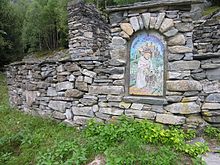
Mosaic embedded in a dry stone wall in Italian Switzerland

Construction
There are several methods of constructing dry stone walls, depending on the quantity and type of stones available. Most older walls are constructed from stones and boulders cleared from the fields during preparation for agriculture (field stones) but many also from stone quarried nearby. For modern walls, quarried stone is almost always used. The type of wall built will depend on the nature of the stones available.
One type of wall is called a “Double” wall and is constructed by placing two rows of stones along the boundary to be walled. The rows are composed of large flattish stones. Smaller stones may be used as chocks in areas where the natural stone shape is more rounded. The walls are built up to the desired height layer-by-layer (course by course), and at intervals, large tie-stones orthrough stones are placed which span both faces of the wall. These have the effect of bonding what would otherwise be two thin walls leaning against each other, greatly increasing the strength of the wall. The final layer on the top of the wall also consists of large stones, called capstonescoping stones or copes. As with the tie stones, the cap stones span the entire width of the wall and prevent it breaking apart. In addition to gates a wall may contain smaller purposely built gaps for the passage or control of wildlife and livestock such as sheep. The smaller holes usually no more than 8  inches in height are called 'Bolt Holes' or 'Smoots'. Larger ones may be between eighteen and 24  inches in height, these are called a 'Cripple Hole'.
Boulder walls are a type of single wall in which the wall consists primarily of large boulders, around which smaller stones are placed. Single walls work best with large, flatter stones. Ideally, the largest stones are being placed at the bottom and the whole wall tapers toward the top. Sometimes a row of capstones completes the top of a wall, with the long rectangular side of each capstone perpendicular to the wall alignment.
Another variation is the “Cornish hedge” or Welsh clawdd, which is a stone-clad earth bank topped by turf, scrub, or trees and characterised by a strict inward-curved batter (the slope of the "hedge"). As with many other varieties of wall, the height is the same as the width of the base, and the top is half the base width.
Different regions have made minor modifications to the general method of construction — sometimes because of limitations of building material available, but also to create a look that is distinctive for that area. Whichever method is used to build a dry stone wall, considerable skill is required. Selection of the correct stone for every position in the wall makes an enormous difference to the lifetime of the finished product, and a skilled waller will take time making the selection.
As with many older crafts, skilled wallers, today, are few in number. With the advent of modern wire fencing, fields can be fenced with much less time and expense using wire than using stone walls; however, the initial expense of building dykes is offset by their sturdiness and consequent long, low-maintenance lifetimes. As a result of the increasing appreciation of the landscape and heritage value of dry stone walls, wallers remain in demand, as do the walls themselves. A nationally recognised certification scheme is operated in the UK by the Dry Stone Walling Association, with four grades from Initial to Master Craftsman.

Using a batter-frame and guidelines to rebuild a dry stone wall in South Wales UK
Newly rebuilt dry stone wall in South Wales UK

Notable dry stone walls
§  Mourne Wall - twenty-two mile long wall in the Mourne Mountains location in County DownNorthern Ireland
§  Ottenby Nature Preserve, built by Charles X Gustav in mid 16th century, Oland, Sweden

Dry stone buildings
While the dry-stone technique is generally used for field enclosures, it also was used for buildings. The traditional turf-roofed Highland Black house was constructed using the double wall dry stone method. When buildings are constructed using this method, the middle of the wall is generally filled with earth or sand in order to eliminate draughts. During the Iron Age, and perhaps earlier, the technique also was used to build fortifications such as the walls of Eketorp Castle (OlandSweden), Maiden Castle, North Yorkshire, Reeth, Dunlough Castle in southwest Ireland and the rampart of the Long Scar Dyke. Many of the dry-stone walls that exist today in Scotland can be dated to the 14th century or earlier when they were built to divide fields and retain livestock. Some extremely well built examples are found on the lands ofMuchalls Castle.

Intihuatana ritual buildings of dry stone at Machu PicchuPeru

Dry stone bridges
Since at least the Middle Ages some bridges capable of carrying horse or carriage traffic have been constructed using drystone techniques. An example of a well preserved bridge of this type is a double arched limestone bridge in Alby, Sweden on the island of Ă–land(shown at right).
Medieval dry stone bridge in Alby, Sweden

Dry-stone markings
In the UK and Switzerland, it is possible to find dry stone constructions without any obvious function. The largest and oldest of them, such as Stonehenge, are likely related to ancient pagan rituals. However, the smaller structures may be built just as signs, marking the mountain paths or boundaries of owned land. (Some stand on the boundary between Italy and Switzerland; see photo). In many countries, cairns are used as road and mountain top markers.
Dry stone marking or cairn

Ancient walls
Some dry-stone wall constructions in north-west Europe have been dated back to theNeolithic Age. Some Cornish hedges are believed by the Guild of Cornish Hedgers to date from 5000 BC, although there appears to be little dating evidence. In County Mayo, Ireland, an entire field system made from dry-stone walls, since covered in peat, have been carbon-dated to 3800 BC. The cyclopean walls of the acropolis ofMycenae have been dated to 1350 BC and those of Tiryns slightly earlier. In Belize, the Mayan ruins at Lubaantun illustrate use of dry stone construction in architecture of the 8th and 9th century AD.
The Lion Gate of the Mycenae acropolis is dry stone

Thursday, 9 February 2012

AGGREGATE


   Construction aggregate, or simply "aggregate", is a broad category of coarse particulate material used in construction, including sand, gravel, crushed stone, slag, recycled concrete and geosynthetic aggregates. Aggregates are a component of composite materials such as concrete and asphalt concrete; the aggregate serves as reinforcement to add strength to the overall composite material. Due to the relatively high hydraulic conductivity value as compared to most soils, aggregates are widely used in drainage applications such as foundation and french drains, septic drain fields, retaining wall drains, and road side edge drains. Aggregates are also used as base material under foundations, roads, and railroads. To put it another way, aggregates are used as a stable foundation or road/rail base with predictable, uniform properties (e.g. to help prevent differential settling under the road or building), or as a low-cost extender that binds with more expensive cement or asphalt to form concrete.
     
    
     The American Society for Testing and Materials publishes an exhaustive listing of specifications for various construction aggregate products, which, by their individual design, are suitable for specific construction purposes. These products include specific types of coarse and fine aggregate designed for such uses as additives to asphalt and concrete mixes, as well as other construction uses. State transportation departments further refine aggregate material specifications in order to tailor aggregate use to the needs and available supply in their particular locations.Sources for these basic materials can be grouped into three main areas: Mining of mineral aggregate deposits, including sand, gravel, and stone; use of waste slag from the manufacture of iron and steel; and recycling of concrete, which is itself chiefly manufactured from mineral aggregates. In addition, there are some (minor) materials that are used as specialty lightweight aggregates: clay, pumice, perlite, and vermiculite.


Strength

Normal concrete strengths are lower than natural aggregates. Most aggregates are stronger than the concrete designed or specified strength. In fact, moderate and low strength aggregates can reduce the stress in cement paste and increase the durability of concrete.

ABSORPTION, POROSITY AND PERMEABILITY
In aggregate, the internal pore characteristics are very important. The size and the continuity of the pores in an aggregate particle are always relate to the strength of aggregate, abrasion resistance, surface texture, specific gravity, bonding capabilities, and resistance to freezing and thawing action. Absorption relates to the particles ability to accommodate liquid. Porosity is a ratio of volume of void to the volume of the solid particle. Permeability refers to the particle’s ability for liquids to pass through. If the rock pores are not connected, a rock may have high porosity and low permeability.


Grading of aggregates
Aggregates which are retained on a 5mm BS sieve and bigger are termed coarse aggregates, while those passing 5mm sieve are termed fine aggregates.
Aggregates are described by their maximum size, graded down, eg 14mm, 20mm or 40mm.
It is important to use well graded aggregates in a concrete mix to achieve the following:
-                    the various sizes of particles interlock, leaving the minimum volume of voids to be filled with cement
-                    the particles flow together readily, ie the mix is workable
-                    a lower water/cement ratio resulting in higher strength of  hardened concrete
-                    maximum density for good strength and durability

BS 882: 1992, Specification for Aggregates from natural sources for concrete, British Standard, gives grading limits for the various particle sizes (see Table 16.1). Aggregates for use in concrete must fall within the limits of the grading curves for coarse and fine aggregate. Fig 16.2  shows the grading limits for the various particle sizes; both for coarse and fine aggregates.


The coarse aggregate can be either;
-single size where nearly all of the particles are within 2 successive sizes,
        eg 5-10mm, 10-20mm or 20-40mm
- graded where the smallest size is 5mm, 
        e.g. 5-14mm, 5- 20mm or 5-40mm.

The BS standard subdivides this into 3 divisions:
-                    fine
-                    medium
-                    coarse

Is there an ideal grading which is applicable to all aggregates?
No, for important work, tests need to be carried out to determine the grading (for the particular type of aggregate)  
which gives maximum workability, economy, density, strength and durability in the concrete.
As a guide, 
a ratio of 1 fine aggregate : 1½ to 3 coarse aggregate is 

satisfactory.